It is a Saturday afternoon in late August, and provisional tax submissions are due Wednesday. A business owner in Bedfordview opens his laptop, types “accountant near me provisional tax help” into Google, scans the first three results, picks one, fills in the contact form, and waits.
By the time he opens the next firm in the list and starts again, he is already gone. The firm he chose first will get the next twelve years of his retainer, his payroll, his year-end statements, his B-BBEE consulting, and his SARS audit support, an annual run rate of roughly R130,000 with multi-year lifetime value comfortably north of R390,000. The firm that lost him will never know about any of it. The contact form he submitted at 3:47 PM on Saturday will sit in an inbox until Monday at 9 AM, forty hours later, by which point the owner has already paid a deposit somewhere else.
This pattern runs through every SA accounting firm during tax season. The breakage sits in the gap between a prospect’s question and the firm’s first response, and it is in that gap that R100,000+ clients quietly walk to whichever firm picked up first.
What this client is worth, and why most firms never run the math
What the case study describes is a median small-business accounting client, not an outlier. The math gets dismissed as theoretical because firms rarely calculate it directly, and the chain of services involved is longer than most owners or partners realise.
For one business client at a small SA firm, the rand value sits around here:
| Service line | Annual rand to the firm |
|---|---|
| Monthly compliance retainer (R3,000 to R8,000 per month) | R36,000 to R96,000 |
| Provisional tax submissions (Aug + Feb) | R2,500 to R6,000 |
| Payroll services (10-employee SMB at R150 to R300 per employee per month) | R18,000 to R36,000 |
| Year-end financial statements | R5,000 to R15,000 |
| Advisory, B-BBEE consulting, VAT and SARS support | R8,000 to R30,000 |
| Annual total | R69,500 to R193,000 |
3-to-5 year retention is the SA accounting industry default. Switching costs are high, partners build trust over multiple tax cycles, and the financial-records handover alone is enough operational friction to keep most clients in place for a decade or more. Lifetime value at the conservative end of that range lands around R390,000, and well past R650,000 at the upper end. The R100,000+ headline number on this page is the floor rather than the ceiling.
A single tax-season weekend run wrong costs a firm a six-figure annuity that will never appear in its books, because the prospect never calls back to explain that he chose someone else.
Five operational failures before the first call
These are the operational failures that show up across SA service-business lead generation, ordered by how often they cost accounting firms a tax-season prospect specifically.
1. The Google Business Profile has no tax-season hours, no tax-season FAQ, no booking link
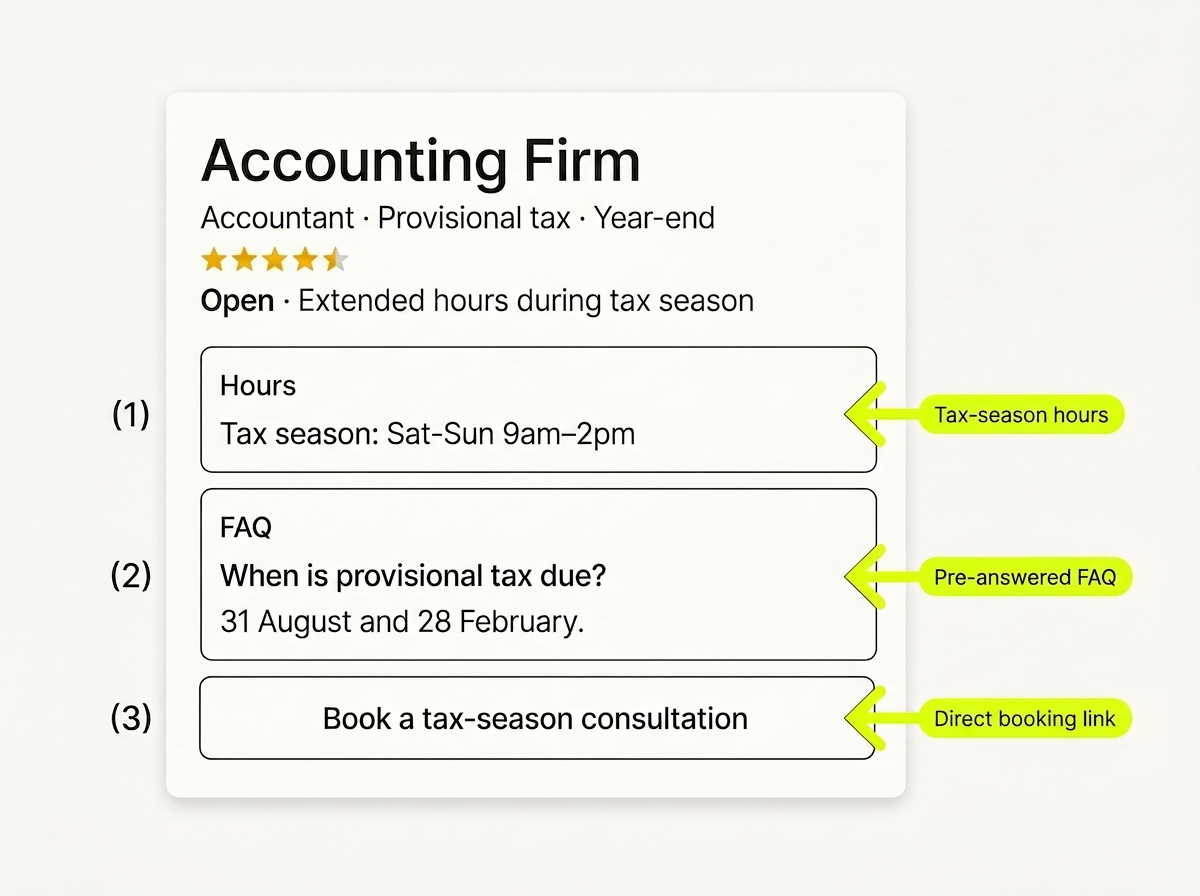
Most accounting firms set up their Google Business Profile once and never revisit it. During tax season the profile needs three things it almost never has. It needs extended-hours messaging that signals the firm is reachable when prospects are actually researching, which is Saturday afternoons, weekday evenings, and the week before provisional. It needs a tax-season-specific FAQ that pre-answers the most common provisional and year-end questions before the prospect even calls. And it needs a direct booking link that takes the prospect from search result to scheduled consultation in two clicks. Without those three, the firm shows up on the search but loses the click to a competitor whose profile signals open and ready.
2. The homepage opens with services rather than the prospect’s actual problem
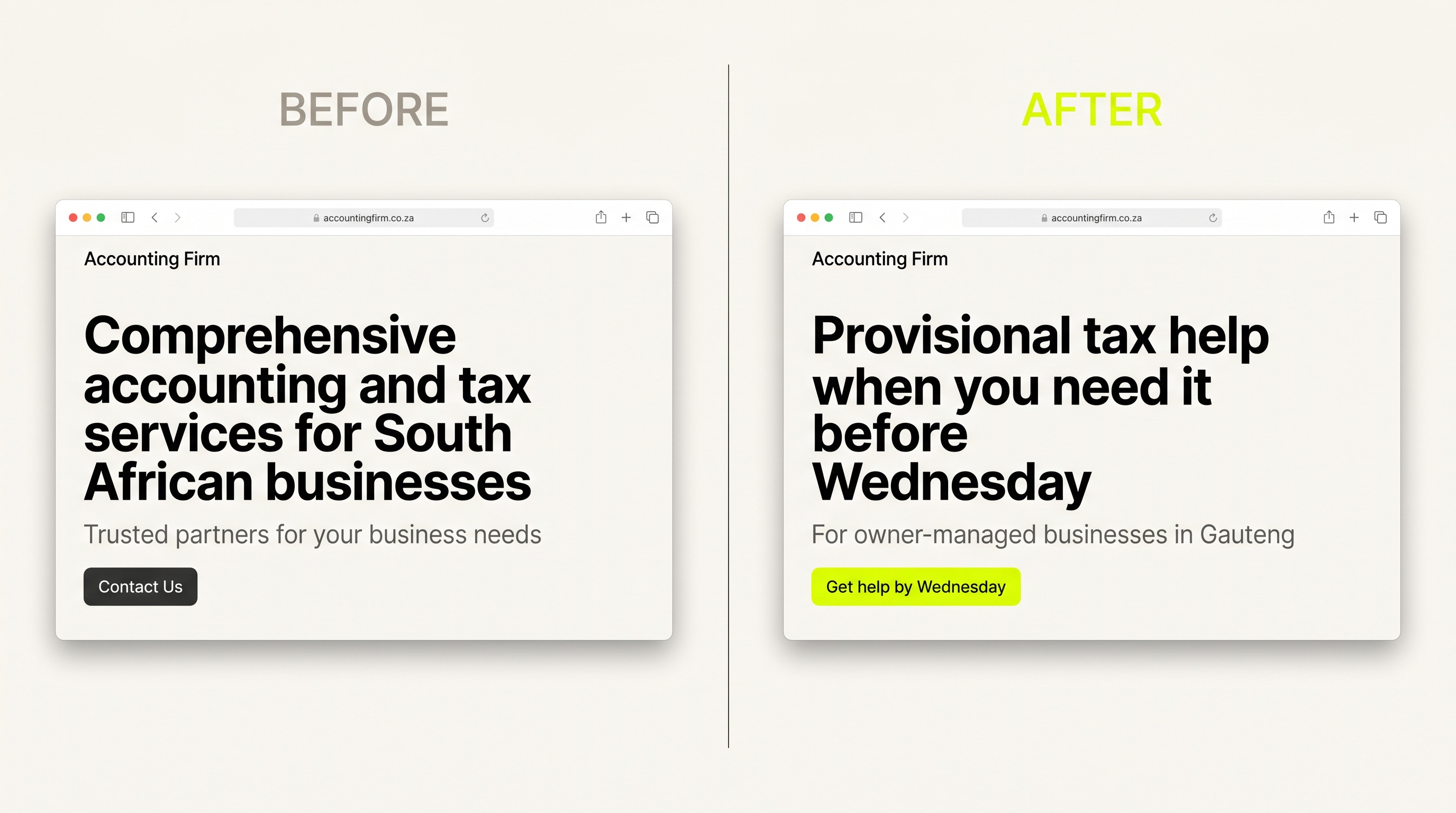
Most accounting firm homepages lead with a list of services such as tax, payroll, accounting, and advisory. The prospect did not search for tax. He searched for “provisional tax help before Wednesday” or “small business accountant Bedfordview” or “SARS audit response,” and the gap between his question and the homepage’s answer is where attention dies. The first 50 words of the homepage need to address the question the prospect actually arrived with, and not the menu the firm wishes he was browsing. We covered this pattern across a different category of business in Why Your Website Gets Traffic But Nobody Calls, and the dynamic is identical for accounting.
3. The enquiry form demands a phone number when the prospect wants to start on WhatsApp
WhatsApp is the default first-contact channel for SA SME enquiries across most service categories, particularly for owners researching outside of work hours. The accounting firm whose contact form requires a name, business name, phone number, email, and a 200-character “tell us about your enquiry” field is filtering out exactly the busier owners it most wants to talk to. The form needs a “WhatsApp us” button as the primary CTA, with the form as a secondary option for prospects who genuinely prefer email-first contact. Forms-only firms are losing the speed-conscious prospects to whichever competitor offers the lower-friction first touch.
4. There is no after-hours response automation
The Saturday afternoon enquiry is the most lucrative enquiry of tax season, because the prospect is researching specifically when his weekday job stops him doing it during business hours. He is comparing three firms tonight, picking one tomorrow, and signing the engagement letter Monday. The firm whose enquiry form produces no acknowledgement until Monday morning is invisible by Monday morning. An automated WhatsApp or email response within five minutes of submission, with a real time-to-human-response and a calendar link, is the difference between making the shortlist and not appearing on it. The five-minute response window matters more than most firms realise, and the data on this is unambiguous; we walked through it in The 5-Minute Rule That Wins 50% of Sales.
5. There is no “who we are best for” page, so prospects cannot self-qualify
Accounting firms specialise more than they advertise. The firm’s actual sweet spot might be 5-to-15-employee retail businesses in Gauteng, sole-prop consultants invoicing R500k to R2m a year, or growth-stage SaaS companies with R5m to R20m in revenue. The website lists “tax, payroll, accounting, advisory” as if those were differentiators when they are simply table stakes. Without a “who we are best for” page, the prospect has no way to self-select before the call, which means the firm spends partner time on first-call conversations with prospects who were never going to fit, and the same partner time that could have closed three good prospects gets spent qualifying out the wrong ones.
Why this is operational rather than creative
The temptation when a firm reads a list like the one above is to commission a website rebuild, and that is almost always the wrong response. The failure point sits in the operational layer that wraps the website, which covers enquiry-handling, response-time, qualification, after-hours automation, lead routing, and calendar booking. A new website with the same operational layer behind it will produce the same lost prospects, only in a more attractive way. We see this constantly: firms commission a R150,000 rebuild, watch the conversion rate barely move, and blame the design when the actual bottleneck was always the enquiries falling through the cracks behind the form.
The structural reason is that most SA accounting firms grew through referrals. The website was set up to look professional for prospects who arrived already half-decided, and the firm’s enquiry-handling process was designed for clients who already trusted the partners. Tax-season prospects fit neither of those profiles; they are cold, time-pressed, comparing three firms in one evening, and deciding on whichever firm makes the next step easiest.
The fix lives in the operational layer rather than in the design work. The website matters in the same way a shop front matters: it has to look credible, but the sale happens at the counter rather than in the window.
What to fix this week
Four moves cover most of the gap, and they take a partner half a Saturday morning total, with no agency required.
Move one: rebuild the Google Business Profile for tax season. Add tax-season hours messaging in the description, an FAQ that answers the five most-asked provisional and year-end questions, and a booking link to a calendar tool the firm already uses. Time required: 90 minutes.
Move two: rewrite the homepage hero block. Replace “Comprehensive accounting and tax services for South African businesses” with a single sentence that names the prospect’s actual question. Something like “Provisional tax help when you need it before Wednesday” or “Year-end statements for owner-managed businesses in Gauteng.” Time required: 60 minutes if the firm has already decided who its sweet spot is, longer if not.
Move three: install a WhatsApp-first contact mechanism. Either a “WhatsApp us” button on every page, or a fully integrated WhatsApp Business setup with an immediate auto-response. Time required: 30 minutes for the button, 2 hours for the full setup.
Move four: install a 5-minute auto-response on every enquiry form. A WhatsApp or email reply that confirms the enquiry was received, sets expectations for time to human response (within 4 business hours, or by 9 AM Monday for weekend submissions), and includes a calendar booking link for prospects who want to skip the back-and-forth. Time required: 90 minutes.
Total time investment is half a Saturday, total cost in tooling sits under R500 per month for any small firm, and the expected impact in tax-season conversion is substantial because the firm is now competing in the response-time race that determines the winner of any given enquiry. We covered the underlying pattern of enquiries vanishing into voicemail in Most of Your Inbound Calls Go Unanswered, Here’s What That Costs.
Eight years and 660,000 customers later
Eight years of building lead generation for service businesses, with around 660,000 paying customers driven across categories along the way, and the conclusion sits in the same place every time. Service-business enquiries break operationally far more often than creatively. The website usually holds up under inspection, the advertising usually holds up, and the Google Business Profile usually holds up. What breaks is the moment between a prospect’s question and the firm’s first response, and the firm that runs the cleanest operational layer wins the enquiry almost regardless of which firm spent more on the brand campaign.
For SA accounting firms during tax season, that operational layer matters more than in almost any other vertical, because the prospect’s decision window is days rather than weeks. The R100,000+ client signs with the firm that made the next step easiest, and rarely with the firm that produced the better tagline.
This is fixable. The four moves above cover the operational basics. For firms handling more than 30 enquiries per month during tax season, where partner time on first-touch responses is itself the bottleneck, there is a productised pilot that runs the WhatsApp-and-web enquiry response, the lead routing, and the calendar booking automatically: R2,497 per month, 60-day pilot, work-for-free if the firm’s response-time targets are not met.
Where to start
Run the audit on your own firm first. The four moves above can be self-installed in a Saturday morning, and that is enough for most firms. If the partner time is not there, or if the firm is doing more than 30 tax-season enquiries a month and the bottleneck is response-time at scale, the AI Automation Respond pilot is built for exactly this pattern. Either way, it is the prospect on Saturday afternoon who decides which firm handles the next twelve years of his retainer, and that decision lands almost entirely on which firm picked up first.